Harvesting – In the Cellar

Winemaking may begin with the picking of the grapes in the vineyards, but when the picking is done it’s only the beginning of the work at the winery.
IMG_2277-300x85

Last Load of Grapes for the Day Arriving

Loads of grapes arrive multiple times a day at the winery. Depending on what time of day the harvest took place, this could be in the wee early hours of the morning or well after dark in the evening. In some location and at some wineries, the grapes are picked during the night when the temperature is the coldest and therefore the grapes remain as stable and healthy as possible. At the winery I work at, we picked during the day and often the last load of grapes wouldn’t arrive to the winery until 9:00pm.

DeStemming

So the grapes have arrived. First things first: are you destemming? If you have machine-harvested the grapes, this has already been done by the machine. Bitter tasting phenols exist in the stems of grapes, and while this can sometimes be desired for red wines, it is avoided with white wines. So into the destemming machine the grapes go. This machine also slightly crushes the grapes, releasing some juice and turning the grapes into “mash”.

IMG_4961-221x300
Destemming Machine

Macerating

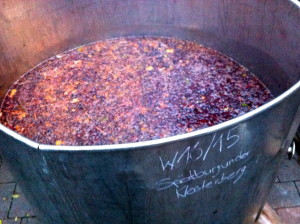
Next, are you macerating the grapes? Maceration is where the grapes (now in mash form) are left in containers to sit “on the skins”. This is particularly important with red wines, as the red colour, as well as flavours, aromas, and tannins, comes from the skins. If you were to press the grapes right away, you would lose these important characteristics.This red skin transfer can also be accomplished by heating the mash. Depending on how long the grapes were left to mingle with the skins, you can end up with a blanc de blanc, weissherbst, or rosé. With certain white grape varietals with very aromatic skins such as Sauvignon Blanc, maceration is also employed. Maceration can happen before, during, and/or after fermentation, depending on the desired outcome. As the mash begins to ferment, the CO2 pushes the grape skins to the top of the container. This can form as cake-like hard layer on the top. Since the point is skin-contact, the wine-maker must “punch” the grapes skins down to mix them.
IMG_4974-300x224

Pinot Noir Macerating

pressing

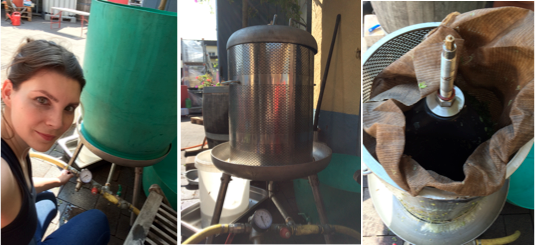
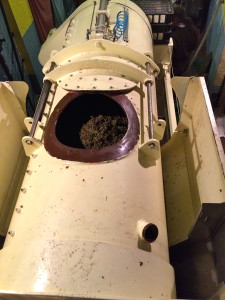
The next action is to press the grapes (or mash in the case of destemmed or macerated grapes). There are a few different types of pressing machines, however most these days work by applying pneumatic pressure to a ballon inside the machine’s vat and forcing the grapes up against the sides of the vat. The juice then flows out through screens and channels and if pumped into a tank.
IMG_2278-225x300

Pressing Machine

clarifying

Ta-da! You have grape juice (now referred to as “must”)! With white wines, before fermentation can occur you need to remove the floating suspended matter in order to turn the natural grey-coloured mash into the crystal clear liquid we expect. Bentonite, charcoal, Kieselgel, Flora Clair, sulfuric acid, and other clarifying products preform this duty. They attract the suspended participles and pull them down to the bottom of the tank. For more information on the clarification process, you can refer to my Clarification blog post.

Screen-shot-2015-09-01-at-10.39.30-PM-300x140

Clarifying Products

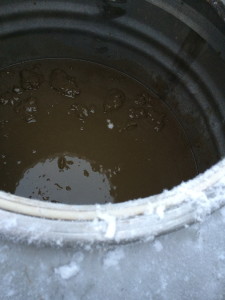
The next step is adding the yeast to begin fermentation and separating the sunken particles from the clarified must. To make this separation, the wine is pumped into a different tank, making sure not to transfer the bottom of the tank containing the settled particles. A second pressing can also occur using the juice from the bottom of the tank mixed with soluble cotton, making sure to squeeze every last drop of grape juice from the clarifying agents and sunken particles. This lower-quality juice is often kept separate from the main juice.
IMG_2334-225x300

Pressed Must + Clarifying Agents + Settled Particles + Soluble Cotton = Ready for Second Pressing

Fermenting

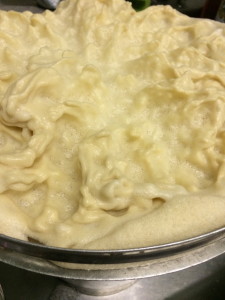
Fermentation is the process by which yeast eats the sugars in the grape juice and convert the sugars into alcohol and CO2. Either you are kicking it back old school and allowing the naturally occurring yeast on the grape skins and in the air at the winery to ferment your wine, or you are adding a known yeast strain that will optimize the rate of fermentation. If adding yeast, you mix the yeast with warm water, wait for it to activate (as seen in the photo below), and then add it to your must. Fermentation generally starts quickly, but should slow down and continue for a couple weeks losing less and less sugar everyday. If fermentation continues too quickly you can lose a lot of aromas. When the alcohol content of the wine reaches about 15 percent, the yeast dies. You can also stop the fermentation process yourself before the yeast has finished eating (thus leaving residual sugars) by cooling the wine down and/or adding sulfur. These decisions are up to the winemaker.
IMG_2283-225x300

Yeast Getting Into Action Before Being Added to the Must

Carbonic maceration is another fermentation option that is used to create really fruity wines such as Beaujolais. In this case the entire grape bunches are put in tanks without being punctured and without yeast being added. Fermentation then occurs within each berry separately and the natural weight of the grape bunches and gravity press the grapes.

chaptalizing & de-acidifying

Further decision the winemaker must make are whether or not to chaptalize or de-acidify the wine. Chaptalization is the process of adding sugar to the wine (before or during fermentation) to increase the alcohol content of the wine. *This does not increase the residual sugars in the wine.* Chaptalization is done in northern wine growing regions/countries such as Germany who don’t get enough sunshine and therefore have grapes with low-sugar. Not enough natural sugar = too low alcohol percentage in the final product. This is not allowed in every country, or with all quality levels of wines. In Germany, if a wine has the acid and sugar levels to qualify as a Grosse Gewachs (equivalent to “Premier Cru”), you are not allowed to chaptalize or de-acidify.

IMG_23271-225x300

Adding Sugar

Another outcome of grapes grown in northern climates such as Germany is high acid contents. Not enough sun means that the sugars don’t develop enough and the juices pressed from these grapes have much too high acid levels. High acid content is more palatable (and to an extent sought after) in certain white wines, such as Riesling. High acids in red wines are avoided as it exaggerates astringency. De-acidifying is the process of adding certain chemicals to remove the acid. The options are to use 2 different salt compounds: calcium carbonate and/or potassium hydrogencarbonate; or malolactic fermentation. Malolactic fermentation is the process by which harsh malic acid is transformed into soft lactic acid. De-acidification should occur prior to fermentation in order to maintain harmonious aroma compounds.

Measuring & Tasting

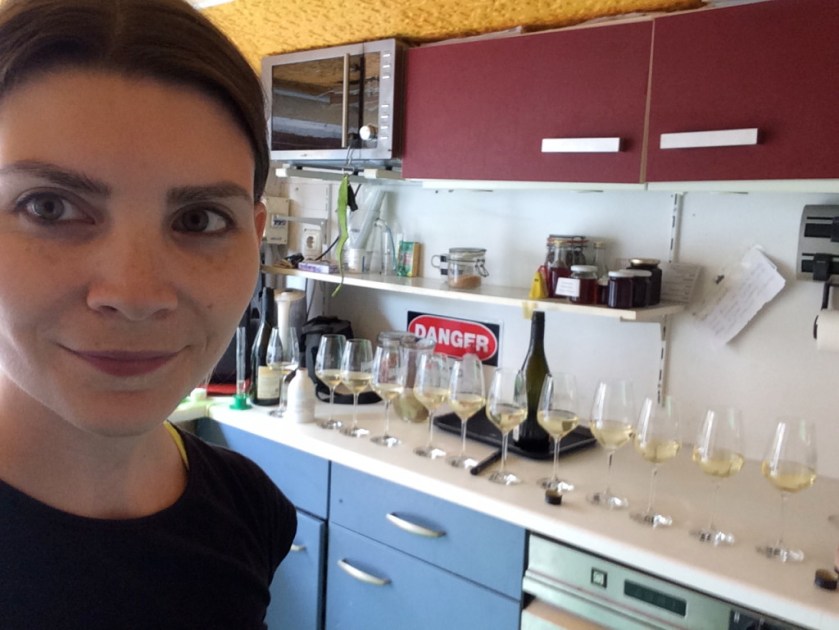
Cellar tastings are an important aspect of the wine-making process. Faults in the wine can be discovered and rectified. Aging and cuvée decisions can be made. Frequent measurements of the wine tells you when fermentation has stopped (and whether you need to try and re-start it or or not) by analyzing the remaining sugar levels. Newly fermenting wines have their own unique aromas and flavours; nothing but a hint of the finished product exists. The fresh fermenting wines taste more like grape juice, with flavours of juicy, sweet fresh fruits such as pineapples and peach. Now you have a cellar full of wines-in-the-making, the fruits of the harvest labour.

IMG_4956-300x224

Cellar Tasting

Cleaning versus Sterilizing

It may come as a surprise, but every corner of a winery does not have to be in sparkling, lemon-fresh, antibacterial condition. Yes, the wine industry is part of the highly regulated food and beverage industry; no we still do not have to wear hair nets.

Now, we are talking within reason. Wineries take measures to keep the majority of fruit flies out of the tanks, and bathroom brushes are certainly not swapped out for cellar brushes even in a pinch. But think about it. Ancient wine presses and cellars existed on open dirt floors, with spiders and people walking freely among the barrels. Some wineries haven’t strayed too far from this tradition, and it’s just fine. Note: the more controlled the environment, the more predictable the wines. For better or worse.

The reason why much of the time wineries do not have to take defence against the living world around it is because of clarifying and filtration methods. For example, the sulfur added to wine after fermentation will knock any unwanted residents out cold. And the final filtration before bottling is so precise and sterile that nothing should be able to get through.

So when is a good rinse down enough, and when is sterilization required? Lets look at some equipment and explore how they are treated.

Tanks: When the must or wine will only remain in the tanks for a short period of time (for example: between picking and pressing), a good rinse and scrub down is sufficient. However, when the wine will remain the tanks for a long period of time (for example; during fermentation or aging), the tanks need to be sterilized. When possible, climbing inside the tanks to first rinse and scrub them is helpful. Then steaming them for 20 minutes at no less than 120 degrees Celsius makes sure they are sterile.

A good interior scrub down and steam bath

Oak Barrels: Barrels need a higher degree of care to maintain. You can’t always get inside these barrels to scrub, but the standard 20 minutes of steam at 120 degrees will kill off everything. To sterilize and preserve the wood further, a sulphur smoke is released into the barrels for 15 minutes. When not in use, the barrels are also filled with a mixture of citric acid, sulfur, and water.

Steam followed by smoke is best for wood

Bottles: I was lucky enough to be able to visit the local wine bottle-sterilizing factory. What makes it unique is that it employs people with mental disabilities. The machine used is new, and is incredibly energy and water-efficient. This factory uses high-level cleaning equipment to remove labels and get left-over junk out of the bottles. It is still high-temperature steam that does the sterilizing. At the winery, immediately before bottling, a sulfur spray can also be used on already clean bottles to just ensure a sterile environment for the newly bottled wine.

IMG_1817-1024x397

Local bottle-cleaning factory

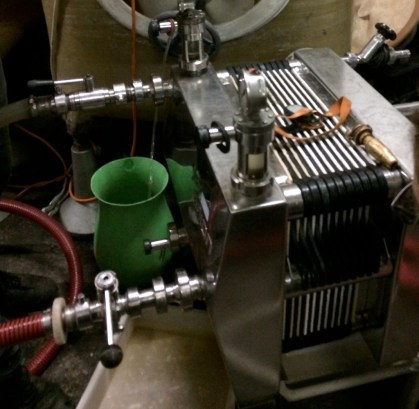
Filters: Before used for filtering, these machines need to be steamed, as the wine passing through needs to remain sterilized from the tank to the bottle. To do this, you run the 120 degree water though the tank from the fine side to the large side of the filter papers. Afterwards, you run cold water through from large to fine side to flush out any paper flavours.

IMG_1850-e1445934431613-1024x1001

Don’t forget to sanitize the filter!

These are just some examples. Many other pieces of equipment, such as hoses, also need to be clean or sterile – depending on the function.

The thing to remember is that wine making can be messy work. But do you taste it in the bottle? Well, you shouldn’t. Wine is like children. Most of the time they are running around and getting dirty, but when it matters, they comb their hair and sit up straight and smile for their school photo.

Bottling

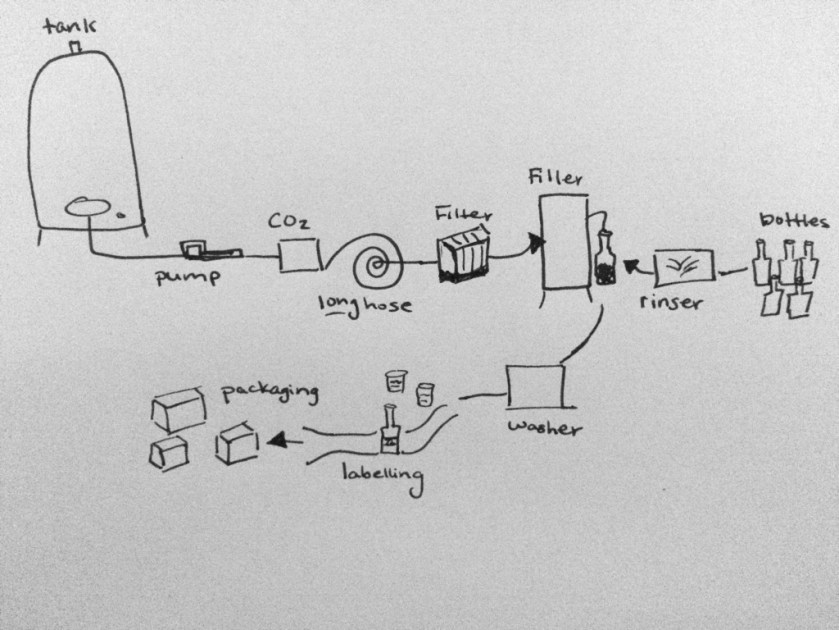
When it comes to the arrangement of machines and stations needed to finally bottle wine, I can’t help thinking of the “Skeleton Dance” song that goes – “The leg bone’s connected to the knee bone. The knee bone’s connected to the thigh bone…”

IMG_2307-1024x768
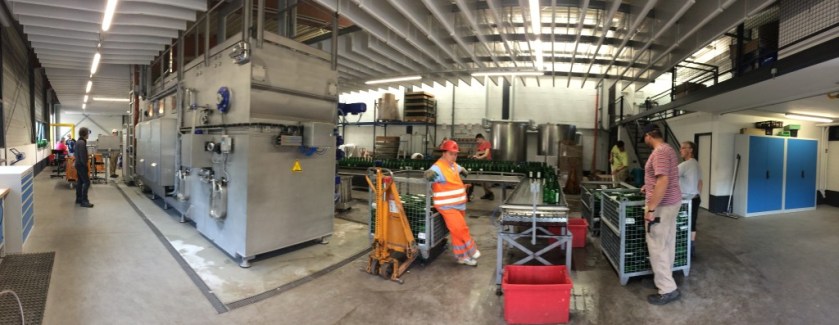
The bottling process

In short, when the wine is ready to be bottled, it is tested one last time for any errors, pumped from the cellar, through the last and sterile filtration, into the bottling machine, where sterilized bottles are filled, capped, and ready to be labeled and packaged.

In a small winery like where I work, much of this process is still done fairly manually. There is no conveyor belt bringing the bottles from one station to the next – this is done by hand.

Screen-shot-2015-10-21-at-3.41.02-PM

Making Bubbly

A few weeks ago I harvested a small number of Müller-Thurgau grapes, pressed them, and clarified and fermented the juice. The question then was to leave it as is, or to go through a second fermentation and make sparkling wine. In the spirit of experimentation and education, I chose to make bubbly!

In order to add the bubbles naturally (versus making a secco where carbon dioxide is simply added to wine), a second round of yeast and sugar is added to the wine, and the bottles are then capped and cellared to be left on the yeast.

Prior to fermentation, the juice had 77ºOechsle (total sugars), which equates to an expected alcohol level of about 10.3%. Using the handy dandy table below, we can see that this means there is 81g of alcohol/L. When making sparkling wine, one can legally add only 1.5% alcohol. 10.3 + 1.5 = 11.8. This means we are enriching just under 12g of total alcohol with sugar for this second fermentation. We must therefore add 2.93kg/100L, or 0.0293kg/1L of sugar to the wine.

IMG_1744-768x1024
Handy dandy table used to convert units

We had 17.5L of wine, so 0.0293kg x 17.5L = 0.512kg. Grams are easier to work with, so 0.512 x 1000 = 512g of sugar needed to be added the 17.5L of wine.

A strain of Sekt yeast was also then added. The rule for this yeast was 20g yeast/100L liquid, or 0.2g/L/1L x 17.5L of wine = 3.5g yeast to be added.

Another thing to note is that the newly fermented wine was stinky. That’s right, really, really stinky. This is a common problem with wine and occurs when the yeast doesn’t have enough sugar to eat. When this happens, the yeast starts eating amino acids – some of which contain sulfur – and produces this farty smell. The way to combat this during the fermentation process is to add nutrients for the yeast to eat. We had done this, but alas we had really hungry yeast. After fermentation, the way to correct this smell is through aeration and copper. We did this and also again added additional nutrients.

IMG_1929-e1443430474798-1024x959
Sterilizing the bottles with sulfur

The next step is to bottle and cap the soon-to-be Sekt. The bottles must first be sterilized. To do this, a sulfur-water solution is sprayed into the bottles. The bottles are then 95% filled with the wine and sealed with a bottle cap.

IMG_1931-1024x768
Enter a caption

Sparkling wine bottles are thicker and stronger than standard wine bottles in order to hold up to the carbon dioxide pressure. Even with these specially designed bottles, you can only have 7.5 bars of pressure within the bottle. Doing our due diligence, we checked this. You get 0.47g of CO2/1g fermentable sugar (and 0.46g alcohol). We had added 512g of sugar. 512g x 17.5L = 29.25. 29.25 x 0.47 = 13.75g CO2. Using a specific table, this equaled exactly 7.5 bars of pressures. Phew!

Finally, the bottles are placed on their sides in a cool, dark place. The amount of time the now sparkling wine remains aging on the yeast cells differs according to country, quality level, and desired flavours. For this experimental wine we plan on only waiting for a minimum of 3 months. With this 3 month wait-time, in December the spent yeast cells will be removed through a process called degorgement, corks inserted, and I will be able to cheers to the new year with my very own bubbly!

Last Minute Alterations

On the verge of the harvest season, it’s out with the old and in with the new! Wine, that is. As we make way for the incoming 2015 grapes to be pressed and cellared, the remaining 2014 wines need to be bottled. Wine makers work all year to grow the grapes, and at minimum they spend a year in the cellar. Clarifying agents have been added. Wine varietals mixed. Acid levels, temperature, residual sugar, and alcohol levels all closely monitored. These two long years result in one final product. So it makes sense that the final moments before sealing the golden juice into bottles are crucial.

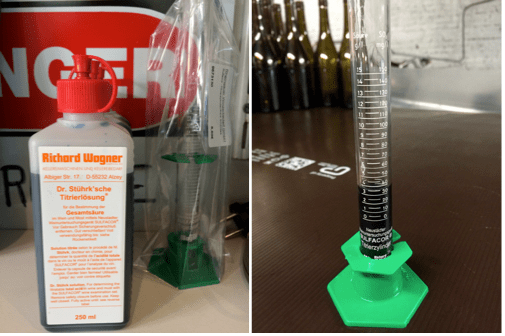
First off, how do you know what last minute alternations need to be made? Sulfur levels are easy to determine. You fill the test tube up to the “0” level with the wine, add a sulfur detecting solution seen in the photo below until the wine turns blue, and presto you know how much sulfur you have and therefore how much more needs to be added. Ideally you want to end up with about 35g/L. You lose some in the bottle, so you want to have about 40(ish)g/L just before bottling.

Screen-shot-2015-10-06-at-8.18.07-AM
Detecting sulfur levels

What about the nuances of taste and feeling that scientific instruments can’t detect? For that you need good old fashion taste buds! For example, adding sweet wine reserve or grape juice can help balance overly acidic wines. Say you have a dry wine with no residual sugar and you know you want to end up with somewhere between 4g-8g residual sugar per litre to enhance the flavour. You take 96ml, 97ml, and 98ml of wine in 3 separate glasses, and add 4ml, 3ml, and 2ml of grape juice to each glass, respectively. Now comes the tasting. What tastes the best? Are flavours and aromas lost or enhanced with different sugar levels? It’s the winemaker’s decision.

IMG_1816-1024x768
Trial time!

There are other last minute additions as well, including adding Arabic Gum (a stabilizing agent found in more products than you would believe). This wonder-product can create a smoother, rounder, fuller mouth feel in wines. And yes, all these alternations have laws guiding quantities, and proper paperwork must always be in order.

Into the tanks and barrels with the wine these last minute additions go.

Next stop – bottling!

Mini Harvest – picking, pressing, clarifying, fermenting

Today, I went through the entire process of collecting grape bunches, separating the good grapes from the bad, pressing, clarifying, and starting the fermentation process. What a crash course for the harvest season!

The winery that I work at has a small amount of grapes vines directly on the property itself. These grapes have been attracting unwanted wasps for the past weeks, so it was time to take them down and make wine!  Let me tell you, it takes nerves of steel and a very zen head-space to remain calm while cutting grapes off vines surrounded by wasps. Surprisingly, I did not get stung once. Not even close. I am a zen master.

After the grapes were cut off the vines, I went through the time-consuming process of cutting out bad, vinegary, blackened, unwanted sections of grapes on the bunches.

Screen-shot-2015-09-01-at-10.32.55-PM
Separating the good from the bad

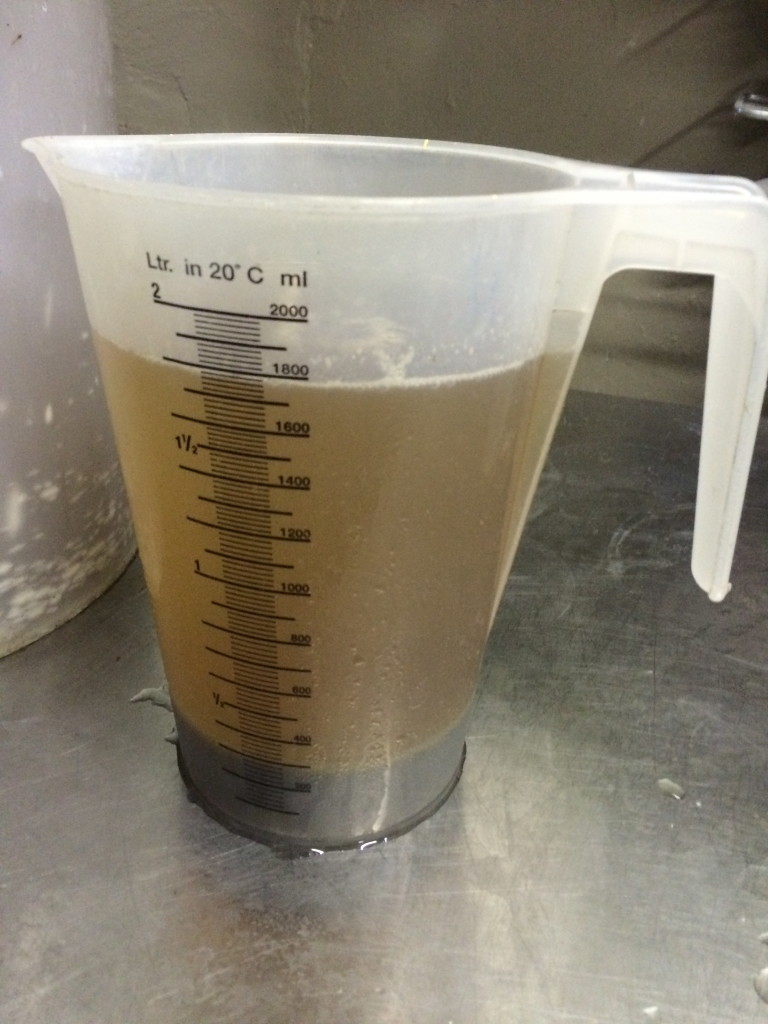
I then took the grapes and was shown how to press them. First we used a traditional press. This was a very lengthy process, requiring time for gravity and pressure to press the juices from the grapes, through the cloth, and out of the filter. I couldn’t believe the dirty grey/brown looking colour of the juice that came out! A degree of murkiness is necessary to give the yeast something to eat and something to hold on to.

IMG_1691-768x1024
Traditional press
IMG_1692-e1441139751708-873x1024
Colour of the must

We then switched to a hydraulic press. This went much faster and we were able to press three times. This press works through water pressure. The cylindrical tub is filled with the grapes, then a balloon in the center of the machine is filled with high-pressure water, pressing the grapes against the tub, through the cloth filter and out of the machine.

Screen-shot-2015-09-01-at-10.37.54-PM
Hydraulic press

After each press, the grapes (or what’s left of them) are moved and stirred by hand. By the third press, grape seeds started to come out of the machine!

When the pressing was done, we measured the sugar and acid levels of the must. Our readings were:

  • 79 Oechsle after first press
  • 77 Oechsle after third press (after the smaller, more acidic grapes are pressed)
  • 5 Acid level
  • 15L must

Then we added the clarifying agents:

  • 7-8g charcoal (5-10% charcoal/ estimated 5-10% rot)
  • 15g Bentonit (50/150g/ 100L)
  • 3g Floral Clair (10-20g? 100L)
  • 8ml Kieselsol (30-100ml/ 100L)
IMG_1703-e1441140864601-1024x544
Clarifying products used

Then it was time to ferment. A Riesling strain of yeast was added to 1 litre water and 1 litre wine. Because the juice was so cold, we left the yeast to begin the fermentation process in the small glass until the larger container warmed up, at which point the contents of the small container were added to the entire 15 litres of must.

Screen-shot-2015-09-01-at-10.40.59-PM
Starting the fermentation

Now each day I must check the sugar level and the temperature of the fermenting wine. I write my findings on a graph and track the changes. Updates to come.

(Also, apologies for mixing German and English terminology. It’s strange learning something new for the first time in a foreign language-I don’t even know some of these terms in English!)

Filtering

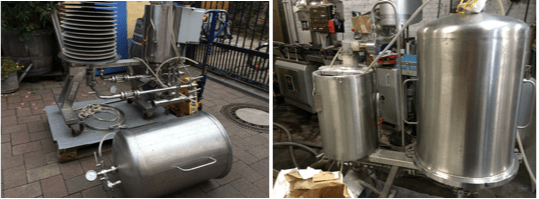
Before the filtering process can even begin, it is important to clean all equipment and machines. This includes all hoses, filters, and tanks. I spend some time cleaning 2 different filters. One is a cylindrical Kieselgur filter with layers of mesh screens, and the other is a rectangular Celluflux filter with metal slots that special paper-type “becopad” sheets are placed on.

Screen-shot-2015-09-01-at-10.15.59-PM
Kieselgur filter used

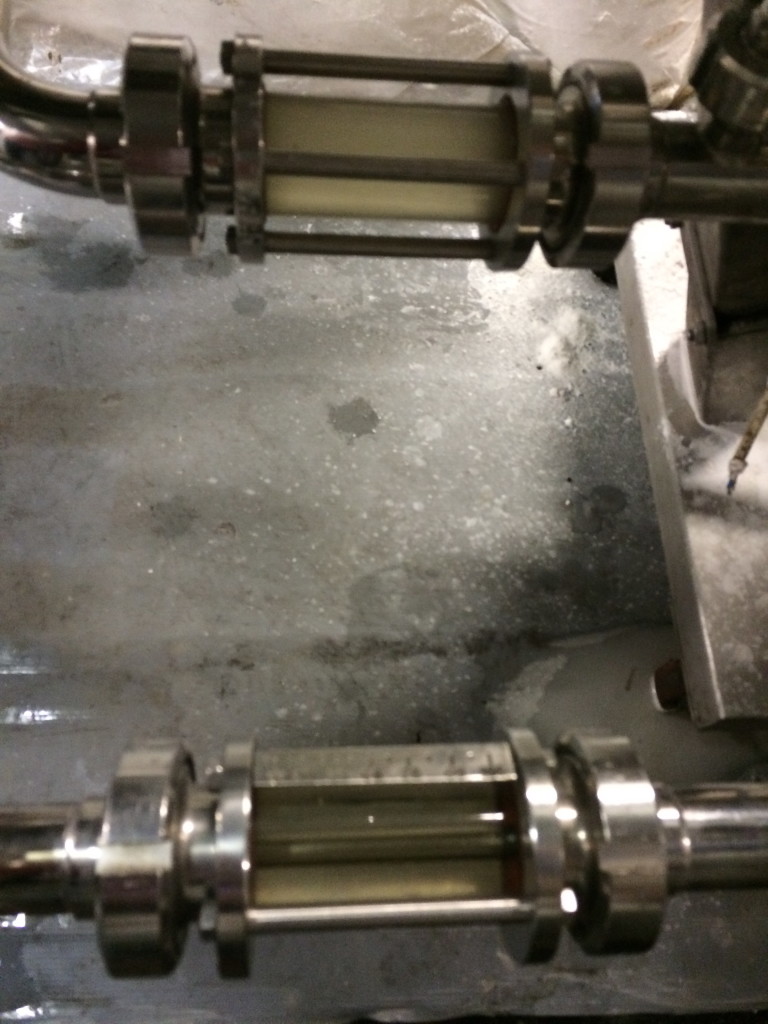
This week we are filtering 3 wines: Auxerrois, Weissburgunder, and Grauburgunder. On the day of filtering, we use the Kieselgur filter. The filtering process happens 4 times using 4 different grades of cellulose powder. Each time a finer power is added to the slurry of wine and forced through the metal screens that then filter out the unwanted particles. Between the second and third filter the difference in the colour and clarity of the wine is clear!

IMG_1532-768x1024
Wine between 2nd and 3rd filtering

The wines are pumped from one tank, through the filtering machine, to another tank. This goes back and forth 4 times during this day of filtering. The wines then go back into the cellar. When it is time to bottle the wines, they will be filtered once more as they go from cellar to tank, then again as they are bottled.

IMG_1531-768x1024
Tank being pumped

Behind the Counter – Wine Tasting

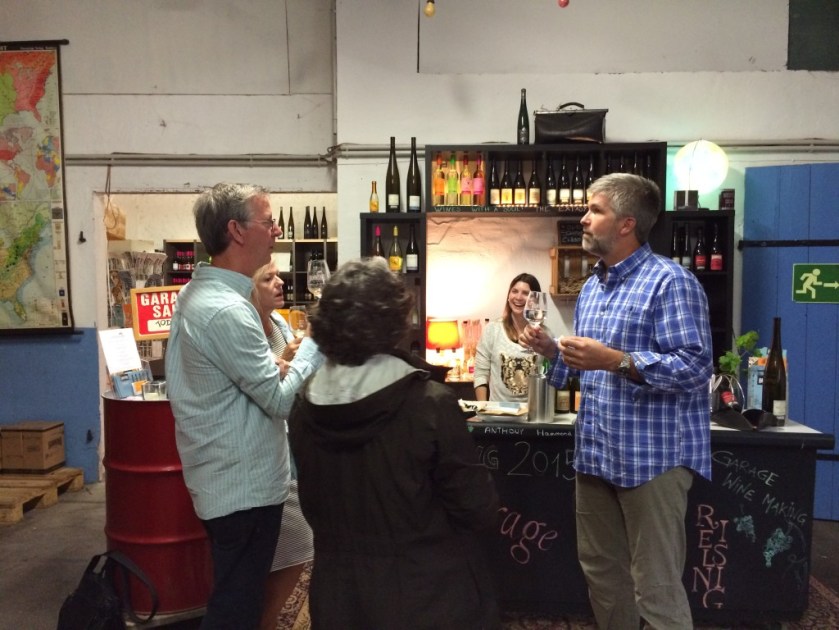
Introducing people to wine you are proud of is the rewarding finale to the year-long-plus of work you know went into making every drop of the good-stuff. With so many wines out there to choose from, when you can share stories behind the wine and the wine making process it adds a level of personal affiliation that connects customers to the wine.

IMG_1655-1024x768
Lively wine discussions

Last week I had the pleasure of leading a wine tasting with some friends from out of town (well, out of country). It was a blast! Here was the count:

  • 2 Seccos
  • 1 Sekt
  • 1 Weissburgunder
  • 1 Grauburgunder
  • 1 Auxerrois
  • 1 Riesling trocken
  • 1 Riesling Kabinett mild
  • 1 Riesling Spätlese mild
  • 1 Spontaneously fermented Riesling Spätlese feinherb
IMG_1594-e1440450733346-1024x417
So many options!

Now, with serious wine tasters, a wine evaluation starts with an assessment of colour, hue, and consistency, then aroma, then the flavour and mouth feel, and finally the finish.

When ascertaining whether a wine is great or not, tasters look for qualities based on the following criteria:

Varietal character: how much the wine represents the grape it comes from

Integration: how well all elements of the wine fuse together harmoniously

Expressiveness: how clearly defined and focused the aromas and flavours of the wine are

Complexity: that intriguing force that pulls you to the wine, sip after sip

Connectedness: how well the wine embodies the land and environment it comes from

This high-level evaluation is certainly not necessary if the point of visiting a winery is simply curiosity and the search for tasty, drinkable wine. However, it is always nice when people feel open to talk about the wine, the flavours, food pairing ideas, etc. This communication makes a tasting a much more interactive and exciting exchange.

In the end, nothing can beat pouring tasting after tasting, telling a story through the order of the wines, engaging in bright conversation, and enjoying a jolly, joyous wine-fueled atmosphere with friends and wine enthusiasts.

Clarifying

The clarification of wine must (juice) works through positive and negative electrical charges or through absorption in order to drag suspended particles down to the bottom of tanks to settle. Various products are used before filtration, during filtration, or just before bottling. Attention! Too much filtration can strip the wine of its flavour and character.

Screen-shot-2015-08-15-at-12.59.27-PM-e1453401527489-251x300
Sediment in tank

The following are brief descriptions of the clarifying products that I have seen used:

Bentonite (negative charge) is added to remove large particles. It comes as a powder-clay consisting of calcium and sodium. After being mixed with water, the slurry is added to the wine. The bentonite chemicals react to the protein elements in the wine (mainly dead yeast), bonding to them, making them heavy, and dragging the now large particles down to the bottom of the tank. The riper the grape, the more bentonite is required.

Activated charcoal (neutral charge) absorbs bad odors and browning colours caused by oxidization.

Silicagel/Kieselgel (negative charge) removed bitterness from wine and clears out haze. It is most commonly used in combination with gelatin.

Egg Whites (positive charge) or the technical term for the protein found in egg whites, Albumin, is used to reduce astringency and decrease spoilage. It is often used in red wines as it doesn’t react with the tannins and also keeps the red colour intact. You can quite literally use the whites of eggs separated from the yolk, but powder form is safer as you reduce the risk of bacteria contamination.

Flora Clair (positive charge) is derived from plant proteins. It is also a gelatin replacement and thus when used can make the wine, technically speaking, vegan.

Sulfuric acid is added to reduce the affect of Acetaldehyde in wine. Acetaldehyde is a naturally occurring organic chemical compound and a by-product of yeast fermentation. It produces a butter-like smell and can cause wine spoilage. Adding sulfuric acid to wine can protect against this. It is a preservative, antibacterial and antioxidant. Sulfites are found naturally in fruits (and thus wine). Therefore, even wines proclaimed to be “sulfite-free” do contain the chemical, it’s just not deliberately added. Fun fact: dried fruits contain much higher quantities of sulfites than wine. Unsurprisingly, sulfite-free wines retain this peculiar scent to some degree.

IMG_1743-768x1024
Example of visible separation