Last Minute Alterations

On the verge of the harvest season, it’s out with the old and in with the new! Wine, that is. As we make way for the incoming 2015 grapes to be pressed and cellared, the remaining 2014 wines need to be bottled. Wine makers work all year to grow the grapes, and at minimum they spend a year in the cellar. Clarifying agents have been added. Wine varietals mixed. Acid levels, temperature, residual sugar, and alcohol levels all closely monitored. These two long years result in one final product. So it makes sense that the final moments before sealing the golden juice into bottles are crucial.

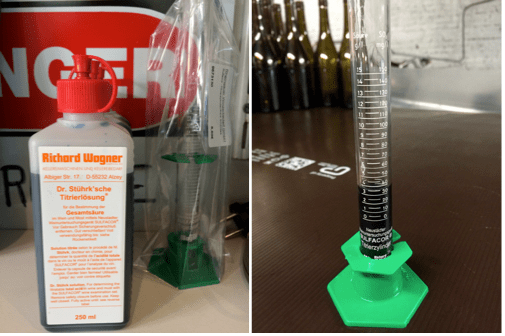
First off, how do you know what last minute alternations need to be made? Sulfur levels are easy to determine. You fill the test tube up to the “0” level with the wine, add a sulfur detecting solution seen in the photo below until the wine turns blue, and presto you know how much sulfur you have and therefore how much more needs to be added. Ideally you want to end up with about 35g/L. You lose some in the bottle, so you want to have about 40(ish)g/L just before bottling.
Screen-shot-2015-10-06-at-8.18.07-AM
Detecting sulfur levels

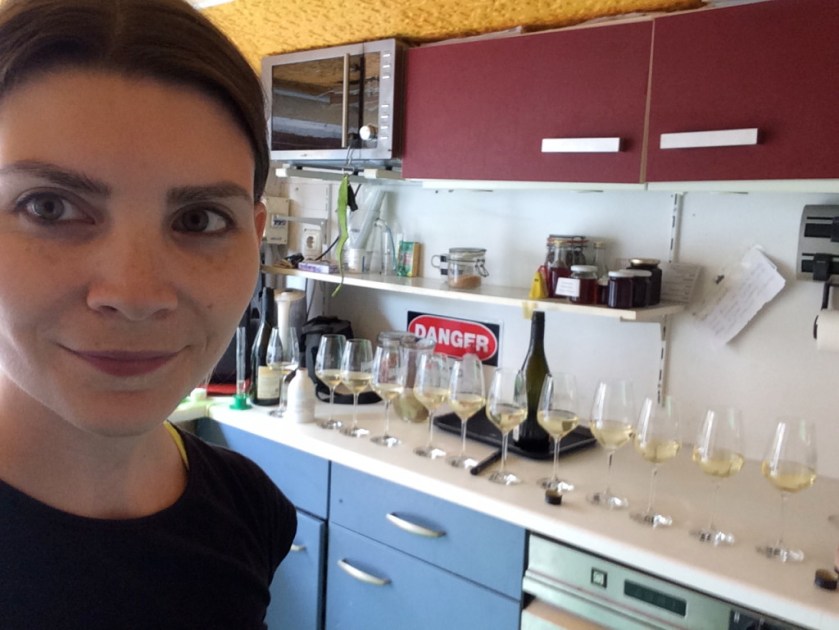
What about the nuances of taste and feeling that scientific instruments can’t detect? For that you need good old fashion taste buds! For example, adding sweet wine reserve or grape juice can help balance overly acidic wines. Say you have a dry wine with no residual sugar and you know you want to end up with somewhere between 4g-8g residual sugar per litre to enhance the flavour. You take 96ml, 97ml, and 98ml of wine in 3 separate glasses, and add 4ml, 3ml, and 2ml of grape juice to each glass, respectively. Now comes the tasting. What tastes the best? Are flavours and aromas lost or enhanced with different sugar levels? It’s the winemaker’s decision.
IMG_1816-1024x768
Trial time!

There are other last minute additions as well, including adding Arabic Gum (a stabilizing agent found in more products than you would believe). This wonder-product can create a smoother, rounder, fuller mouth feel in wines. And yes, all these alternations have laws guiding quantities, and proper paperwork must always be in order.

Into the tanks and barrels with the wine these last minute additions go.

Next stop – bottling!

Mini Harvest – picking, pressing, clarifying, fermenting

Today, I went through the entire process of collecting grape bunches, separating the good grapes from the bad, pressing, clarifying, and starting the fermentation process. What a crash course for the harvest season!

The winery that I work at has a small amount of grapes vines directly on the property itself. These grapes have been attracting unwanted wasps for the past weeks, so it was time to take them down and make wine!  Let me tell you, it takes nerves of steel and a very zen head-space to remain calm while cutting grapes off vines surrounded by wasps. Surprisingly, I did not get stung once. Not even close. I am a zen master.

After the grapes were cut off the vines, I went through the time-consuming process of cutting out bad, vinegary, blackened, unwanted sections of grapes on the bunches.

Screen-shot-2015-09-01-at-10.32.55-PM
Separating the good from the bad

I then took the grapes and was shown how to press them. First we used a traditional press. This was a very lengthy process, requiring time for gravity and pressure to press the juices from the grapes, through the cloth, and out of the filter. I couldn’t believe the dirty grey/brown looking colour of the juice that came out! A degree of murkiness is necessary to give the yeast something to eat and something to hold on to.

IMG_1691-768x1024
Traditional press
IMG_1692-e1441139751708-873x1024
Colour of the must

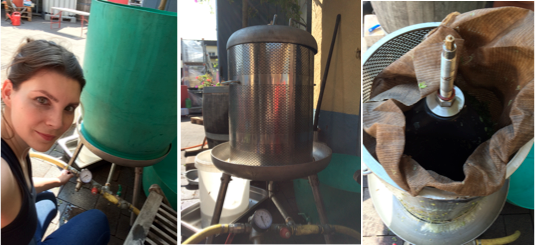
We then switched to a hydraulic press. This went much faster and we were able to press three times. This press works through water pressure. The cylindrical tub is filled with the grapes, then a balloon in the center of the machine is filled with high-pressure water, pressing the grapes against the tub, through the cloth filter and out of the machine.

Screen-shot-2015-09-01-at-10.37.54-PM
Hydraulic press

After each press, the grapes (or what’s left of them) are moved and stirred by hand. By the third press, grape seeds started to come out of the machine!

When the pressing was done, we measured the sugar and acid levels of the must. Our readings were:

  • 79 Oechsle after first press
  • 77 Oechsle after third press (after the smaller, more acidic grapes are pressed)
  • 5 Acid level
  • 15L must

Then we added the clarifying agents:

  • 7-8g charcoal (5-10% charcoal/ estimated 5-10% rot)
  • 15g Bentonit (50/150g/ 100L)
  • 3g Floral Clair (10-20g? 100L)
  • 8ml Kieselsol (30-100ml/ 100L)
IMG_1703-e1441140864601-1024x544
Clarifying products used

Then it was time to ferment. A Riesling strain of yeast was added to 1 litre water and 1 litre wine. Because the juice was so cold, we left the yeast to begin the fermentation process in the small glass until the larger container warmed up, at which point the contents of the small container were added to the entire 15 litres of must.

Screen-shot-2015-09-01-at-10.40.59-PM
Starting the fermentation

Now each day I must check the sugar level and the temperature of the fermenting wine. I write my findings on a graph and track the changes. Updates to come.

(Also, apologies for mixing German and English terminology. It’s strange learning something new for the first time in a foreign language-I don’t even know some of these terms in English!)

Behind the Counter – Wine Tasting

Introducing people to wine you are proud of is the rewarding finale to the year-long-plus of work you know went into making every drop of the good-stuff. With so many wines out there to choose from, when you can share stories behind the wine and the wine making process it adds a level of personal affiliation that connects customers to the wine.

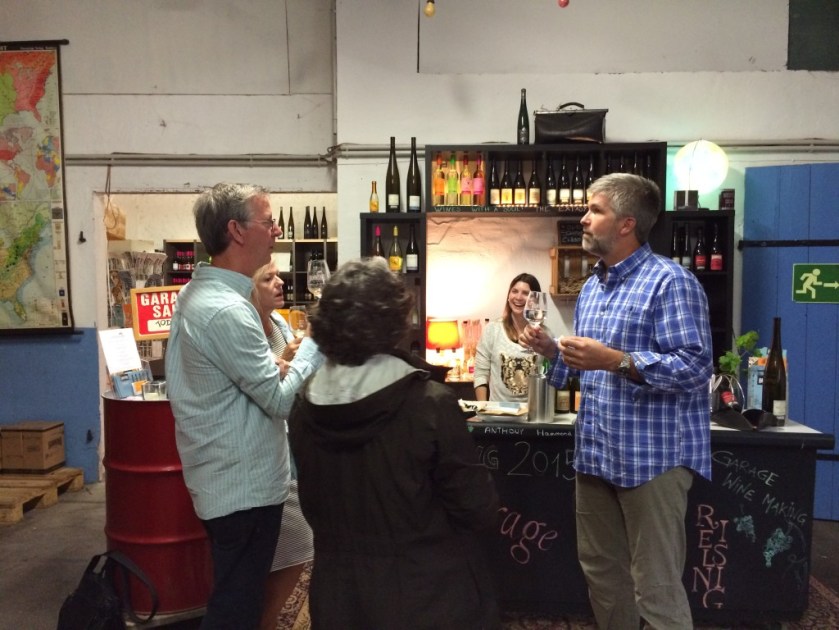
IMG_1655-1024x768
Lively wine discussions

Last week I had the pleasure of leading a wine tasting with some friends from out of town (well, out of country). It was a blast! Here was the count:

  • 2 Seccos
  • 1 Sekt
  • 1 Weissburgunder
  • 1 Grauburgunder
  • 1 Auxerrois
  • 1 Riesling trocken
  • 1 Riesling Kabinett mild
  • 1 Riesling Spätlese mild
  • 1 Spontaneously fermented Riesling Spätlese feinherb
IMG_1594-e1440450733346-1024x417
So many options!

Now, with serious wine tasters, a wine evaluation starts with an assessment of colour, hue, and consistency, then aroma, then the flavour and mouth feel, and finally the finish.

When ascertaining whether a wine is great or not, tasters look for qualities based on the following criteria:

Varietal character: how much the wine represents the grape it comes from

Integration: how well all elements of the wine fuse together harmoniously

Expressiveness: how clearly defined and focused the aromas and flavours of the wine are

Complexity: that intriguing force that pulls you to the wine, sip after sip

Connectedness: how well the wine embodies the land and environment it comes from

This high-level evaluation is certainly not necessary if the point of visiting a winery is simply curiosity and the search for tasty, drinkable wine. However, it is always nice when people feel open to talk about the wine, the flavours, food pairing ideas, etc. This communication makes a tasting a much more interactive and exciting exchange.

In the end, nothing can beat pouring tasting after tasting, telling a story through the order of the wines, engaging in bright conversation, and enjoying a jolly, joyous wine-fueled atmosphere with friends and wine enthusiasts.