
It may come as a surprise, but every corner of a winery does not have to be in sparkling, lemon-fresh, antibacterial condition. Yes, the wine industry is part of the highly regulated food and beverage industry; no we still do not have to wear hair nets.
Now, we are talking within reason. Wineries take measures to keep the majority of fruit flies out of the tanks, and bathroom brushes are certainly not swapped out for cellar brushes even in a pinch. But think about it. Ancient wine presses and cellars existed on open dirt floors, with spiders and people walking freely among the barrels. Some wineries haven’t strayed too far from this tradition, and it’s just fine. Note: the more controlled the environment, the more predictable the wines. For better or worse.
The reason why much of the time wineries do not have to take defence against the living world around it is because of clarifying and filtration methods. For example, the sulfur added to wine after fermentation will knock any unwanted residents out cold. And the final filtration before bottling is so precise and sterile that nothing should be able to get through.
So when is a good rinse down enough, and when is sterilization required? Lets look at some equipment and explore how they are treated.
Tanks: When the must or wine will only remain in the tanks for a short period of time (for example: between picking and pressing), a good rinse and scrub down is sufficient. However, when the wine will remain the tanks for a long period of time (for example; during fermentation or aging), the tanks need to be sterilized. When possible, climbing inside the tanks to first rinse and scrub them is helpful. Then steaming them for 20 minutes at no less than 120 degrees Celsius makes sure they are sterile.


A good interior scrub down and steam bath
Oak Barrels: Barrels need a higher degree of care to maintain. You can’t always get inside these barrels to scrub, but the standard 20 minutes of steam at 120 degrees will kill off everything. To sterilize and preserve the wood further, a sulphur smoke is released into the barrels for 15 minutes. When not in use, the barrels are also filled with a mixture of citric acid, sulfur, and water.


Steam followed by smoke is best for wood
Bottles: I was lucky enough to be able to visit the local wine bottle-sterilizing factory. What makes it unique is that it employs people with mental disabilities. The machine used is new, and is incredibly energy and water-efficient. This factory uses high-level cleaning equipment to remove labels and get left-over junk out of the bottles. It is still high-temperature steam that does the sterilizing. At the winery, immediately before bottling, a sulfur spray can also be used on already clean bottles to just ensure a sterile environment for the newly bottled wine.
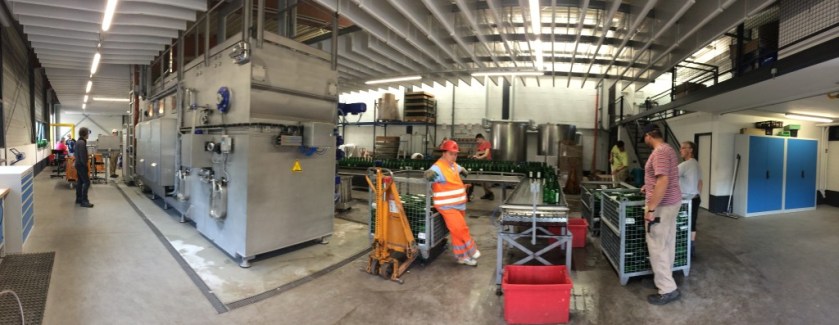
Local bottle-cleaning factory
Filters: Before used for filtering, these machines need to be steamed, as the wine passing through needs to remain sterilized from the tank to the bottle. To do this, you run the 120 degree water though the tank from the fine side to the large side of the filter papers. Afterwards, you run cold water through from large to fine side to flush out any paper flavours.
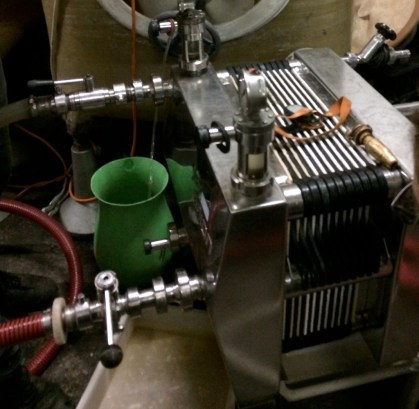
Don’t forget to sanitize the filter!
These are just some examples. Many other pieces of equipment, such as hoses, also need to be clean or sterile – depending on the function.
The thing to remember is that wine making can be messy work. But do you taste it in the bottle? Well, you shouldn’t. Wine is like children. Most of the time they are running around and getting dirty, but when it matters, they comb their hair and sit up straight and smile for their school photo.
 heatheruncorked.com