
For those who don’t know, Prowein is the world’s leading trade fair for wine professionals, held each year in Düsseldorf, Germany. What does that means in terms of numbers? Well let’s quickly do the math. It lasts 3 days, 9 hours each day, and there are over 6,000 exhibitors from 57 countries. 3×9/6,000= an impossible number of booths to visit during the fair.
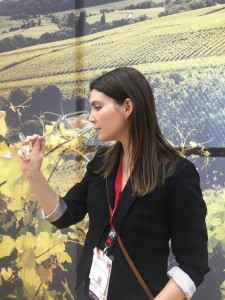
So where do you start? Most visitors are here to find business opportunities. They represent a distribution channel for the wine producers. They are importers, exporters, distributors, restaurants, etc. It’s a bit like a matchmaking service. I attended the fair as a student of International Wine Business/winery apprentice/blogger/curious, future-thinking wine professional in the making. I knew I had only one day at Prowein and that I needed to narrow down my plan of attack. Luckily, I know what I like in a wine region.
Tradition in wineries is important, but as the New World has shown, not necessary. I am most attracted to wines and wineries that don’t play by the rules of tradition. Of course inspiration and know-how can be drawn from, for example, the great French wine regions of Burgundy, Bordeaux, or the Loire, but New World wine regions such as Niagara, Okanagan, Oregon, and Washington State, can take that knowledge and run in whichever direction they choose. What best represents the terroir? Growing conditions? Grape varieties? And importantly, what unique message they want to project through their wine?
Like the core upon which the New World was founded, the wine scene there is freeing and makes space for creativity. Would you ever see a Chardonnay-Riesling blend in France? Non. Is Megalomaniac winery in Niagara making a fantastic one? Oui.
OH CANADA
With my focus on the Americas, I was able to stay in one hall of the fair dedicated to the New World – U.S.A., New Zealand, South Africa, Brazil, Canada, Australia, etc. As a Canadian whose wine heart still resides in Canada, I beelined it for the Wines of Canada stand promptly as the doors opened. Here I met many fantastic Canadians making world class wine.
Winemaker and Vice President of Vineland Estates Winery, Ontario, Brian Schmidt, can tell you everything you need to know about his wine. Later in the day I would speak with a French importer of his wines, Justine Coudert from World Wines Hunter. (Side note: I need to find where these Canadian wines are hiding internationally so I can stop hoarding my Canadian treasures and start enjoying more of them.)
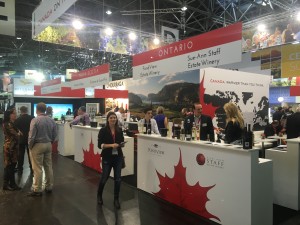
Vigneron and Owner of Hidden Bench Vineyards and Winery in Beamsville, Ontario, Harald Thiel, spoke about his commitment to environmental stewardship and low-impact winemaking. As someone with a background in environmental sustainability, to me this is really fantastic.
Gilles Chevalier, President and Co-Managing partner at Domaine Queylus in St. Ann’s, Ontario proclaimed that when he and 14 or so partners decided to jump into wine making in 2006, it was better that he new nothing rather than a little about grape growing and winemaking. He focuses on the marketing and leaves the winemaking to Thomas Bachelder, 2009 winemaker of the year.
From the west coast of Canada, John W. Skinner, Owner of Painted Rock Estate Winery in Penticton, B.C. has his sights set on the international arena. He exports 55% of this wine already, and is setting himself apart by tearing down the image that Canadian wines can only be sold to a local audience.
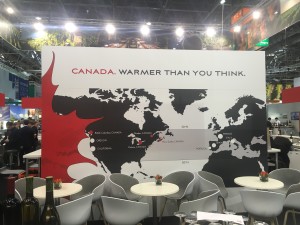
In total there were 22 wineries from British Columbia, Ontario, and Nova Scotia represented at the Wines of Canada booth:
British Columbia:
Bench 1775 Winery, Okanagan Valley
Burrowing Owl Estate Winery, Okanagan Valley
C.C. Jentsch Cellars, Okanagan Valley
Church & State Wine, Okanagan Valley
Gold Hill Winery, Okanagan Valley
Okanagan Crush Pad, Okanagan Valley
Painted Rock Estate Winery, Okanagan Valley
Poplar Grove Winery, Okanagan Valley
Quails’ Gate Winery, Okanagan Valley
Wild Goose Vineyards, Okanagan Valley
Ontario:
Colio Estate Wines, Lake Erie North Shore
Flat Rock Cellars, Niagara Peninsula
Hidden Bench Vineyards, Niagara Peninsula
Lakeview Cellars, Niagara Peninsula
Pelee Island Winery, Lake Erie North Shore
Pillitteri Estates Winery, Niagara Peninsula
PondView Estate Winery, Niagara Peninsula
Domaine Queylus, Niagara Peninsula
Sue-Ann Staff Estate Winery, Niagara Peninsula
Vineland Estates Winery, Niagara Peninsula
Nova Scotia:
Benjamin Bridge, Gaspereau Valley
Domaine de Grand Pré, Annapolis Valley
I even found a Canadian wine enthusiast from the Netherlands named Jurgen van der Vlugt, owner of a small wine importing company Étoiles du Nord. One of the great joys in my life is educating those around me about the quality of wines coming out of Canada (and not just ice wine!). Jurgen seems to be championing this cause himself. A kindred spirit.
the best parts of wineland USA
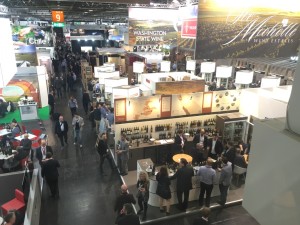
Moving on to my favourite American wine region, Washington State, I met Sean P. Sullivan, Contributing Editor or the Wine Enthusiast and founder of the Washington Wine Report, as he presented a seminar on Washington and its wine. I learned that contrary to popular belief, not all of Washington is rain-cloud covered. What?! Yes, it’s true. The vineyards are positioned on the east side of the Cascade Mountain and in fact receive so little rain that they must irrigate. It’s a warm, dry, continental climate. Also, because the area is so large you get small microclimates throughout Washington’s growing regions. This gives “varietal tempicity”, in Sean Sullivan’s eloquent words. The sandy soil of the region also means that they do not suffer from phylloxera and therefore use the natural rootstock in lieu of grafting. Now that’s pretty darn cool.

We tasted 2 wines – one white and one red. The first was a L’Ecole No 14 Columbia Valley 2014 Semillon-Sauvignon blend. It has hints of vanilla, tropical fruits such as pineapple and mango, citrus, and an oak influence. This is how I like my wine – interesting, complex, and mouthwatering – making me want to go for sip after sip while getting more and more out of it. The red was a Browne Family Vineyards Columbia Valley 2013 Cabernet Sauvignon. This showed blackberry, black cherry, and chocolate notes, as well as barrel toasting. These two next to each other are like ying and yang. Chocolate and vanilla. Delightful!

I also tasted through some Charles Smith Wines. I love the labels almost as much as I love the wine! Big Syrahs, well balanced Merlots, acidic Rieslings. What more could you want? These brands are funk-tastic. I want to jump on a plane immediately and visit this winery.
Now go one state south and Oregon’s growing climate is starkly different from Washington’s. This is a wet, coastal maritime climate. One winery of particular note is Howard Rossbach’s Firesteed Cellars in the Willamette Valley. He has had this winery since 1992 and has been working in the wine business since 1972. To be honest, there is little reason for an owner of a winery to speak with me at this point in my career, let alone make me feel welcome. This man is a jewel and has a great spread of wines.

For fun I also tasted through some New York State wines. There were some interesting lightly oaked Chardonnays and, rather surprisingly, a Lemberger (Blaufrankisch). What the heck is that doing here?! I believe that good wine can be made just about anywhere given passionate vignerons and winemakers. Unfortunately, I don’t think this area has yet to attract enough talent to move forward and make wines that one would choose over another. It’s definitely an area I will keep my eye on as it develops though
A shout out to my Germany
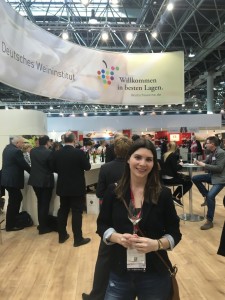
As most of my wine education thus far has been in Germany, I am familiar with, and naturally very interested in, further developing my German wine knowledge. Just as I feel at home at the Canadian and Washtingon State wine stands, Germany also feels welcoming. The Deutsches Weininstitut (German Wine Institute) was showing wines from all around Germany. They gave a tasting presentation of Schloss Vollrads and Robert Künstler wines. This informative seminar was meant to extend the efforts of the German Wine Institute in educating the world on Germany’s fantastic Riesling selections. As one who believes firmly in the greatness of German Rieslings, I hope the message got through to others and will be spread far and wide.
Honourable mention
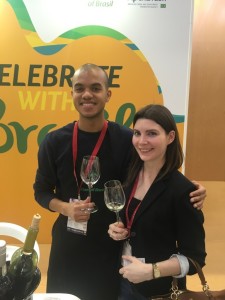
An honourable mention goes to Wines of Brazil. I know what you’re thinking. Brazil makes wine? I mean Portugal does, but have I ever seen a bottle of Brazilian wine? I’m pretty sure I haven’t. Luckily, one of my International Wine Business classmates is Brazilian and he showed me some of the Brazilian wines being poured at Prowein. Most important to note is that they make it sweet and they make it bubbly. That’s how they like it. Sweet style sparkling wines are very popular. And hey, if that is what you go in expecting – versus a French Champagne – you’d be quite pleasantly surprised. In fact, I also tried a champagne-style 50% Chardonnay and 50% Pinot Noir blend Extra Brut with 6g residual sugar and it was very lovely as well. There you go. Now you and I know that Brazil makes wine.
After eight hours at Prowein my feet were ready to call it quits. I hope that when I return next year it will be in an even more professional capacity. Either that or I’m just going to go next year for the free drinks. I kid, of course. Mostly, at least.
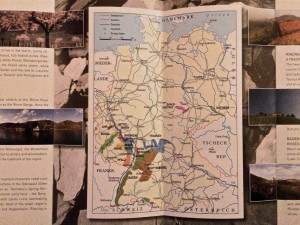
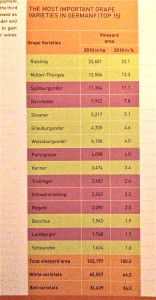 In total Germany is home to 100 white grape and 40 red varieties. Germany is the largest producer of Riesling in the world, and the third largest producer of Pinot Noir (Spätburgunder in German). German Pinot Noirs have unfortunately not been given the public accolades they rightly deserve. The market associates dark red wines with quality and flavour (think Bordeaux) and Germany produces a much lighter coloured product; delicious and worthy in it’s own respect. German wines also have an excellent price-quality ratio, at an average of 2.89 Euros/Litre. The quality level of German wines are so high due to the fact that Germany does not protect the sale of its own wines through import taxation (Germany has 0% tax on wine), and instead competes with the rest of the wine market on the value of quality.


 heatheruncorked.com