August Kesseler Tasting

Spring has sprung and I have finally found a few moments to write a post. With the sun shining and a glass of Rheingau Riesling by my side, I feel like writing a few words about some of August Kesseler winery wines. First off, what fantastic labeling they have! Really uncomplicated, bold, modern, colourful, simplistic, eye-catching, and fun.

The August Kesseler winery resides in the village of Assmannshausen in the Rheingau, with its vineyards located in Assmannshausen, Rüdesheim and Lorch. Assmannshausen is known for high quality red wines in this otherwise predominately white wine Riesling wine region of Germany.

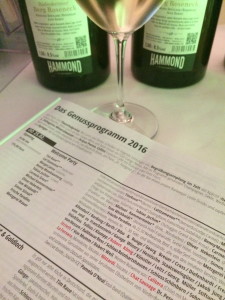
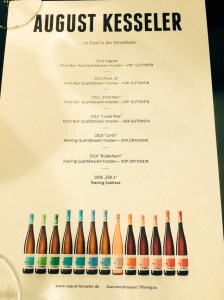
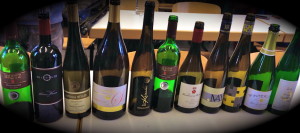
I attended a tasting of August Kesseler wines a little while back and wrote down some tasting notes of the 7 wines provided. Allow be to stretch my currently much under worked tasting note writing muscle as I try my best to describe these wines.
One

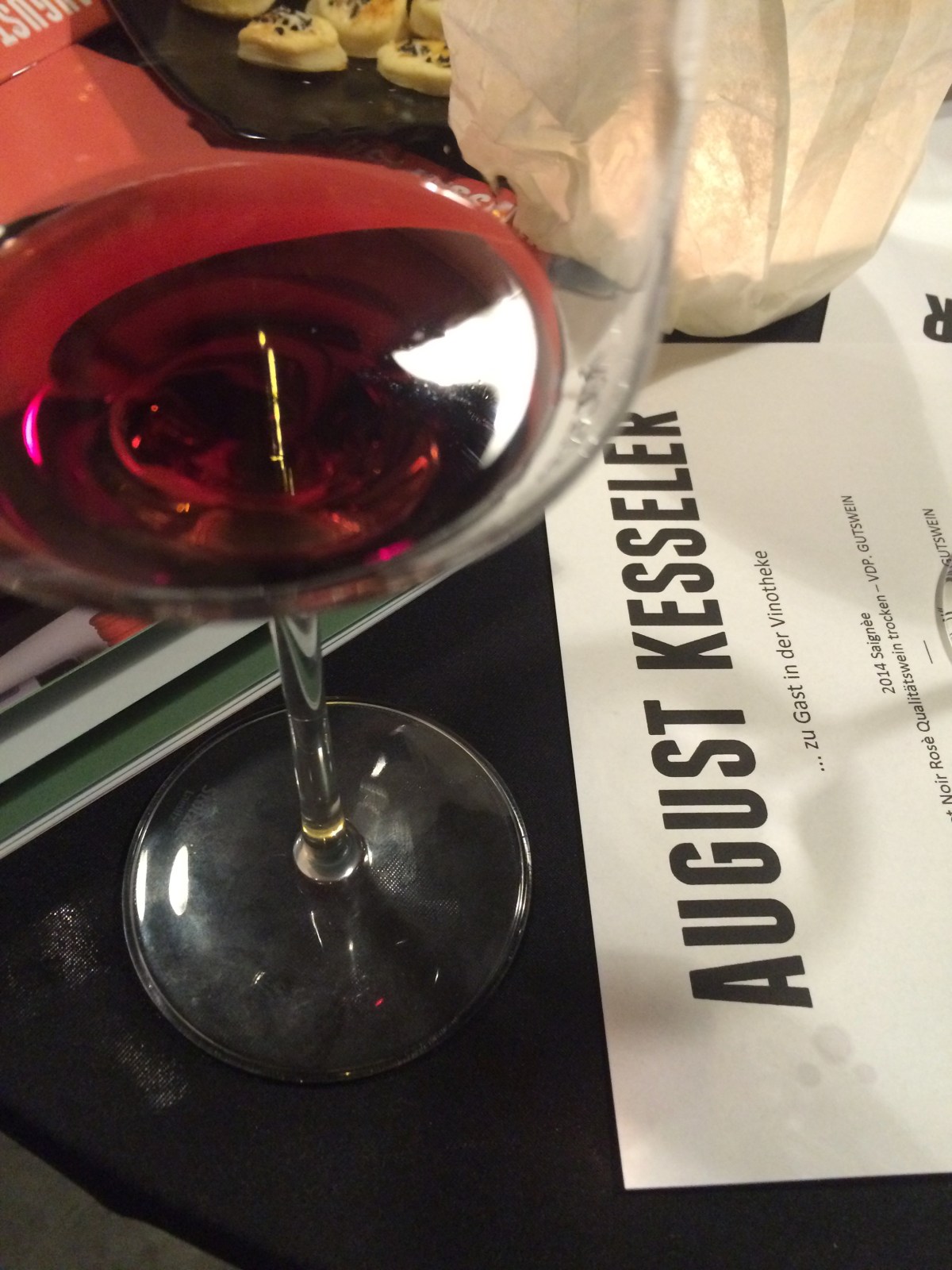
2014 Saignée

Saignée, French for “bleeding”, is a rosé made purely from red wine (no mixing). It is taken as mash directly following the red wine pressing, allowing the remaining red wine increased skin contact concentration during maceration, while the rosé wine is fermented separately. Ok, lesson over. This rosé punches full force with strawberry, raspberry and cassis aromas, and a refreshing hit of acidity. A paradox in a bottle – the dry and fruity characteristics of this wine makes it the perfect summer sipper, yet its juicy, full-flavoured elegance and power calls for a brisk autumn evening meal accompaniment. A most versatile rosé to enjoy anytime.

Two

2012 Pinot Noir “N”

Lightly oaked with 2.4-4g of total acidity, this low acid Pinot Noir is mellow and easy-drinking. Bordering on too simplistic, this wine relies on its classic cold climate Pinot Noir sour cherry and red current fruits.

Three

2011 Pinot Noir

This is the epitome of how an Assmannshausen Pinot Noir should taste. Less sour cherry, more berries and deep, mineral elegance. Aged significantly in oak barrels, stewed fruits dominate, adding a sweet quality to this dry wine.

Four

2013 “Cuvée Max” Pinot Noir

Confronting the taster with a wild, untamed nose, this heavy-weighted, pricey PInot Noir jumps around on the tongue. Dominant tannins and a dark smokiness play along side a subtler sour cherry and cassis light fruitiness. This Big Red aches to be tamed by the invitation of food.

Five

2013 “Lorsch” Riesling

The Lorsch terroir and extreme minerality exude from this dry Riesling, as notes of honey, white pear, peach, green apple and citric grapefruit unfold on the palette sip after sip.

Six

2014 “Rüdesheim” Riesling

Dim hints of stone fruits, cassis, prune and canned peach provoke the senses upon first meeting. A hit of anise and a floral character follow. Slate on the nose, acidity and soft minerality on the tongue, and a clean finish round out this atypical Riesling.

Seven

2006 “530.3” Riesling

Honouring the kilometre marker to Holland in the Rheingau River, this golden-coloured Spätlese with 60g sugar is looking good for its age. After 10 years, the expected petrol aromas are soft and the viscosity moderate. This drinks like a sweet, if yet otherwise, normal wine. Dried apricots and dried pineapple are pronounced and delightful, but most exciting perhaps is the – wait for it – while chocolate flavour that lingers on the palette.

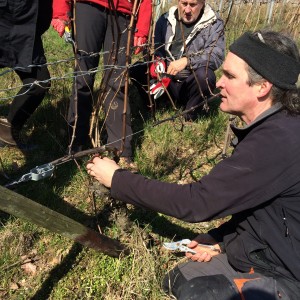
Pruning in the Winter

Why Prune?

One of the first rules of grape growing is: struggle = reward. This is why artificially watering vines, even in times of drought, is generally disproved of (or illegal) in order to make sure the roots grow deep and strong and lead to more resilient vines. When it comes to the production of grape clusters, you want to aggressively prune branches in order to condense the available nutrients into each grape berry. Too many grapes fighting over limited nutrients a great wine does not make. You need to keep the quantity low and quality high.

In fact, quality designations in wine are partially derived from the amount of grapes picked from vineyards. Each country has it’s own regulation. For example, in France the AOC regulates the allowed yields. In Germany’s VDP classifications, the basic “classic” wines can be harvested at a yield of 100 hectare litres/ hectare; after that it drops drastically to 60hl/ha for all other succeeding “selection” quality designations. In addition to protecting the consumer by regulating quality, this also helps avoid more overproduction in an already saturated market.

In the first months of the new year, when the vines are dormant, you select which vine branches will be kept to produce that year’s grapes. Branches that are too new, or grow spontaneously from the bottom of the trunk, lack genetic information that tells them how to grow grapes. Keeping old vines means an unruly, unmanageable trellis with too many grapes and branches fighting for a limited energy supply.

How to Prune

Cane Pruned vs. Spur Pruned Vines

There exist two different methods to prune grape vines: cane pruning and spur pruning. The decision on pruning style depends on the quality of the branch-growths available, and then how you train the branches to grow (though certain pruning styles are more effective for certain grapes varieties).

image-21-e1456686103970-300x300

First: Instructions on How to Prune

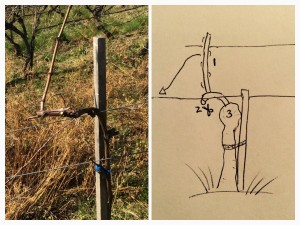
For cane pruned vines, as a basic rule of thumb, you count from 1 to 3 to understand which branches to keep and which to cut. 1=last year’s branch that will grow this year’s shoots and grapes; 2=branch from 2 years ago; and 3=the head – in old vines the gnarly looking nub that is connected by 2 or 3 years to the original trunk that gets larger and larger with pruning.

image-22-e1456686139766-225x300

The “Head” of the Cane System

By cutting the 2-branch at the point just after the 1-branch, you are keeping the branch that will grow this year’s grapes as close to the trunk, and therefore energy supply, as possible. The 1-branch gets bent around the bottom metal trellis wire (like the 2-branch as seen in the photo below) and then grows new shoots up towards the sun and sprout grape clusters.

Officially speaking, for this year’s growth the 1-branch is called the cane, the 2-branch the arm, and the 3-branch the head.

image-23-300x225

The 1-2-3 Method of Cane Pruning

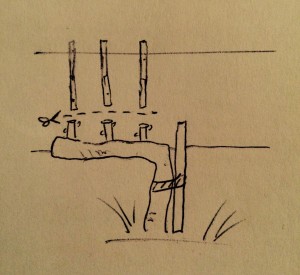
With spur pruning, a long, thick, semi-permanent branch called the cordon grows horizontal along the trellis wire from the trunk. From the cordon, spurs grow up and produce the grape shoots. With pruning, you are essentially giving dormant canes a hair cut and they are now called spurs. This method is simpler to understand and execute.

image-20-e1456682547510-300x275

Spur Pruning a Cordon System

Learning Curve

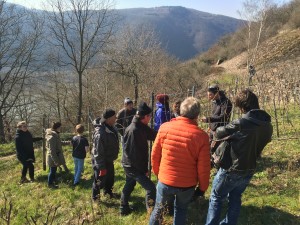
On Saturday, in sunny 7ºC weather, I, along with members of Garage Winery’s vine sponsorship community, met on the hills of Rüdesheim above the Rhein River to learn about pruning and try our hand at the process. It is quite upsetting to see such large pieces of healthy vines be cut. It takes some time to come to terms with the fact that the branches grow back during the season and that this truly is the best way to keep the grapes as healthy and flavour-packed as possible. After all, wines are the result of not only the wine making process, but of decisions made to the raw material in the vineyards. So go ahead and prune those vines. No pressure.

image-15-300x225
Make sure you cut the right branches!

Rheingau Gourmet & Wein Festival

Thursday, February 25th, 2016: It’s opening night of the 20th annual Rheingau Gourmet & Wein Festival. 10 world class chefs have been flown in from around the world to prepare dishes, and 30 Rheingau wineries are set to pour their wine and sekt.

IMG_3077-225x300

Top Chefs from Germany and Around the World & 30 Rheingau Wineries

Held within the Lay Brothers’ Dormitory of the historic Kloster Eberbach, the guests arrived dressed to impress. However, this was not the time to wear anything too restricting around the waist line. Guests wandered amongst the many food and wine booths looking to see what tickles their fancy. By the end of the night the goal is – or should be – to try everything. You are, after all, here to experience all the great food and wine on offer.

IMG_3052-e1456516813527-287x300

Plating for nearly 200 people

Anthony Hammond of Garage Winery and Hammond Wines in Oestrich Winkel kindly invited me to experience this event and help pour. We served magnums of his full-bodied, rich and crisp, semi-sweet 2009 Berg Roseneck Riesling Spätlese to guests, while at the same time indulging ourselves in the interesting food and wines available. Interestingly, some Germans still have an ingrained aversion to sweet rieslings. I think this harkens back to the prominent days of Liebfraumilch and other such once-high-quality-turned-low-quality sweet German wines that ravaged the globe, and to this day still (foolishly) represent German wines in many parts of the world. But with over 10 magnums poured in under 5 hours, this wine was a welcomed alternative to dry Rieslings provided by other wineries.

FullSizeRender-1-290x300

Winemaker Anthony Hammond and Myself

The Food: To start, I had the foie gras with black truffle vinaigrette, red beet essence, and brioche toast. This, as well as a goose liver mousse (served in an avant garde-esque gold-coloured egg), was the perfect accompaniment to the semi-sweet spätlese I was pouring at this event. Divine! Fatty and salty paired with the deep fruity sweetness. There was veal from Wiesbaden’s Michelin star restaurant, Die Ente, salmon cakes from Chef Benny Masekwameng from South Africa, many others, including a white chocolate-mango ganache from Kronenschlösschen, Hattenheim for dessert.

image-24-300x225

Foie Gras with Hammond’s 2009 Berg Roseneck Riesling Spätlese, and White Chocolate-Mango Ganache

The Wine: Some wines of particular note from this evening’s event include a 2007 Chardonnay brut Sekt from Bardong winery, with delightful notes of brioche; a 2014 Siegelsberg dry Riesling from Schloss Reinhartshausen, with super explosive, exciting fruitiness and acidity to balance; as well as a stellar Pinot Noir from Robert König winery.

A mere 24 hours later and I feel like Cinderella. Last night, stellar food from top star chefs; today, Domino’s pizza. Though to be honest, I do love me my pizza nearly as much as fancy food. Shhhhh…

Spreading the Deliciously Crisp Word – Germany & German Wine

Last month the German Wine Institute (Deutsches Weininstitut) based in Mainz presented to my International Wine Business class. This two-day seminar was first lead by Mr.Bretchi, Head of Education, and then Mr.Schindler, Head of Marketing. The German Wine Institute is Germany’s wine marketing organization, charged with promoting German wines domestically and internationally. You see, German wines have had a bad reputation since the rise in popularity of Liebfraumilch, a sticky sweet, once high-turned low quality, heavily exported wine-in-a-blue-bottle. Sweet, one note wines have thus become synonymous with German wines, leaving a lot of work for the German Wine Institute to restore a proper image of the nation’s wealth of world-class wines.

IMG_2533-300x225

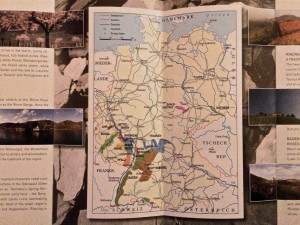
German Wine Growing Regions

In truth, Germany has a lot to offer the wine consumer. It is a cold grape growing climate, meaning that refreshing acids are nice and high, and alcohol is low. This style makes for absolutely perfect food pairing wine. It also has a long growing season, giving the grapes times to mature slowly and delicately, resulting in an increase in fruity flavour and aromas. The majority of vineyards are located on steep slopes along large rivers, meaning that the grapes grow in a warmer-than average, and naturally regulated micro-climate.

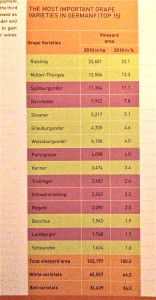
IMG_2532-156x300In total Germany is home to 100 white grape and 40 red varieties. Germany is the largest producer of Riesling in the world, and the third largest producer of Pinot Noir (Spätburgunder in German). German Pinot Noirs have unfortunately not been given the public accolades they rightly deserve. The market associates dark red wines with quality and flavour (think Bordeaux) and Germany produces a much lighter coloured product; delicious and worthy in it’s own respect. German wines also have an excellent price-quality ratio, at an average of 2.89 Euros/Litre. The quality level of German wines are so high due to the fact that Germany does not protect the sale of its own wines through import taxation (Germany has 0% tax on wine), and instead competes with the rest of the wine market on the value of quality.
Germany is the 15th largest wine producing country, with 102,000 hectares of vineyards, and the 4th largest wine market in the world. There are 13 wine-producing areas in the country, each with their own specialities and regional marketing activities. There are roughly 16,000 families owning vineyards. 1/3 of the wine produced comes from wine estates, 1/3 from coops, and 1/3 from bottlers who buy grapes and turn them into wine. In total Germany produces 9million hectare litres of wine, but is a thirsty nation and consumes about 20million hectare litres.

IMG_2451-300x133

Tasting wines from various German wine regions

Unfortunately, due to the somewhat sullied image of German wines, combined with overwhelming labelling terminology (checkout this amazingly helpful page on how to read a German wine label), German wines have not risen as far as they should on the world stage. Wine gurus such as Robert Parker deliver top praise for the German high-quality sweet wines Trockenbeernauslese and Eiswein, but continue to over look Germany’s stellar dry wines.

The goal of the German Wine Institute is thus to show the world what German wines are made of. How do they do this?

The German Wine Institute is funded by wineries through the mandatory payment of 67 Euros/Hectare/Year. This gives them roughly 11million Euros per year to work with. They spend much of this money on marketing/advertising, but also make money through event and seminar hosting, product sales, etc.

IMG_2452-300x225

Educational materials about German wines courtesy of the German Wine Institute

For the past number of years, marketing strategies have been mostly aimed at promoting Riesling. This has been what the German Wine Institute has based it’s image on. A fresh, fruity, dry, crisp, clean, classic, elegant, aromatic, food-pairing wine. And this is working. Initiatives such as Generation Riesling have been a huge success – making the image surrounding German wines more youthful and vibrant. The German Wine Institute also tries to expose the public to German wines through wine tourism activities, press releases/trips, events and fair, seminars and classes, educational materials, Riesling lounges in restaurants, social media, the German Wine Queen competition, some sponsorship, supermarket advertising, and agreements with foreign offices. This work is carried out both in the Mainz headquarters, as well as through their international offices. The German Wine Institute employs PR firms in a select number of cities around the world to promote the wonderful world of German wines.

Since moving to Germany in 2013, I have grown to think of Riesling as the most regal and well-rounded of grape varieties. German wines are not French or Italian or Chilean. They are unique. They represent the terroir they come from and the love and labour that goes into making them.

If I were you, I’d go right now and find myself a Riesling Spätlese trocken from the Rheingau or the Mosel region, chill it, pour a glass, and enjoy. Prost!