
Last month the German Wine Institute (Deutsches Weininstitut) based in Mainz presented to my International Wine Business class. This two-day seminar was first lead by Mr.Bretchi, Head of Education, and then Mr.Schindler, Head of Marketing. The German Wine Institute is Germany’s wine marketing organization, charged with promoting German wines domestically and internationally. You see, German wines have had a bad reputation since the rise in popularity of Liebfraumilch, a sticky sweet, once high-turned low quality, heavily exported wine-in-a-blue-bottle. Sweet, one note wines have thus become synonymous with German wines, leaving a lot of work for the German Wine Institute to restore a proper image of the nation’s wealth of world-class wines.
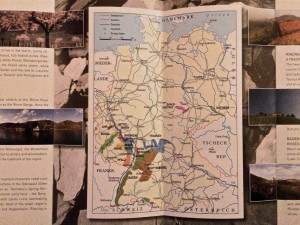
German Wine Growing Regions
In truth, Germany has a lot to offer the wine consumer. It is a cold grape growing climate, meaning that refreshing acids are nice and high, and alcohol is low. This style makes for absolutely perfect food pairing wine. It also has a long growing season, giving the grapes times to mature slowly and delicately, resulting in an increase in fruity flavour and aromas. The majority of vineyards are located on steep slopes along large rivers, meaning that the grapes grow in a warmer-than average, and naturally regulated micro-climate.
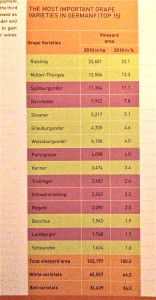 In total Germany is home to 100 white grape and 40 red varieties. Germany is the largest producer of Riesling in the world, and the third largest producer of Pinot Noir (Spätburgunder in German). German Pinot Noirs have unfortunately not been given the public accolades they rightly deserve. The market associates dark red wines with quality and flavour (think Bordeaux) and Germany produces a much lighter coloured product; delicious and worthy in it’s own respect. German wines also have an excellent price-quality ratio, at an average of 2.89 Euros/Litre. The quality level of German wines are so high due to the fact that Germany does not protect the sale of its own wines through import taxation (Germany has 0% tax on wine), and instead competes with the rest of the wine market on the value of quality.
Germany is the 15th largest wine producing country, with 102,000 hectares of vineyards, and the 4th largest wine market in the world. There are 13 wine-producing areas in the country, each with their own specialities and regional marketing activities. There are roughly 16,000 families owning vineyards. 1/3 of the wine produced comes from wine estates, 1/3 from coops, and 1/3 from bottlers who buy grapes and turn them into wine. In total Germany produces 9million hectare litres of wine, but is a thirsty nation and consumes about 20million hectare litres.
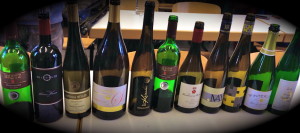
Tasting wines from various German wine regions
Unfortunately, due to the somewhat sullied image of German wines, combined with overwhelming labelling terminology (checkout this amazingly helpful page on how to read a German wine label), German wines have not risen as far as they should on the world stage. Wine gurus such as Robert Parker deliver top praise for the German high-quality sweet wines Trockenbeernauslese and Eiswein, but continue to over look Germany’s stellar dry wines.
The goal of the German Wine Institute is thus to show the world what German wines are made of. How do they do this?
The German Wine Institute is funded by wineries through the mandatory payment of 67 Euros/Hectare/Year. This gives them roughly 11million Euros per year to work with. They spend much of this money on marketing/advertising, but also make money through event and seminar hosting, product sales, etc.

Educational materials about German wines courtesy of the German Wine Institute
For the past number of years, marketing strategies have been mostly aimed at promoting Riesling. This has been what the German Wine Institute has based it’s image on. A fresh, fruity, dry, crisp, clean, classic, elegant, aromatic, food-pairing wine. And this is working. Initiatives such as Generation Riesling have been a huge success – making the image surrounding German wines more youthful and vibrant. The German Wine Institute also tries to expose the public to German wines through wine tourism activities, press releases/trips, events and fair, seminars and classes, educational materials, Riesling lounges in restaurants, social media, the German Wine Queen competition, some sponsorship, supermarket advertising, and agreements with foreign offices. This work is carried out both in the Mainz headquarters, as well as through their international offices. The German Wine Institute employs PR firms in a select number of cities around the world to promote the wonderful world of German wines.
Since moving to Germany in 2013, I have grown to think of Riesling as the most regal and well-rounded of grape varieties. German wines are not French or Italian or Chilean. They are unique. They represent the terroir they come from and the love and labour that goes into making them.
If I were you, I’d go right now and find myself a Riesling Spätlese trocken from the Rheingau or the Mosel region, chill it, pour a glass, and enjoy. Prost!
 heatheruncorked.com