
Apart from perhaps Chardonnay, when you think of France, you think of red wines, n’est-ce pas?
From different regions, with different grapes varietals, and at different quality levels, this journey through French whites paints a fairly inclusive picture of the French white wine scene. Obviously this is not a complete showing of all white wines available in France, but it is a starting point to understanding the range of whites available.
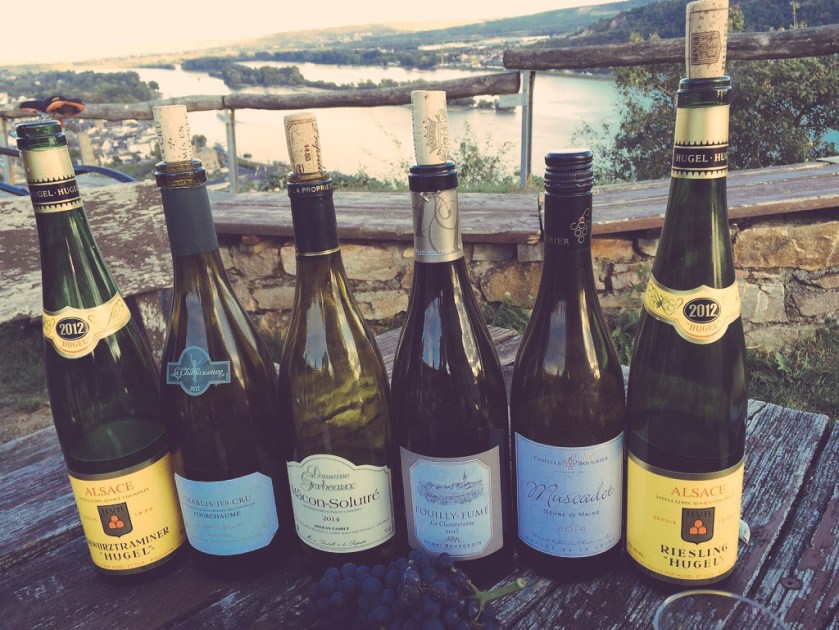
From right to left:
2012 Riesling, Alsace
Alsace is a region of France that boarders Germany. In fact, the land has been tossed back and forth between German and French rule throughout the centuries. Understanding this, the production of Riesling makes sense as an extension of the German quality of the region.
Alsace is the only area in France that names its wines based on the grape varietal, thus making it the easiest wine region in France to understand. The vast majority of wine is also made by producers, rather than by specific châteauxs.
This dry Riesling has floral and minerality on the nose. Petrol notes are already evident in the 3 year-old wine. This wine presents itself a little creamy – a change from many of the clear and unmuddled Rieslings throughout Germany. In true Riesling style, it has the trusted acidic kick. At 12%, the alcohol is evident in the body and flavour. Flavours of under-ripe plums, limy citrus, flint, wood, and stone. Has a big, long, floral finish.
2014 Muscadet, Loire
This wine is made from the Melon de Bourgogne grape, and yet is not from Bourgogne (Burgundy in English). It comes from the Loire region closest to the Atlantic Ocean. This is important in understanding the coastal conditional under which these grapes grow, versus continental.
This wine reminds me of a Sauvignon Blanc in that it has a vegetal and floral quality. It is light and has notes of honey, anise, and sage.
2013 Pouilly-Fumé, Loire
This wine is 100% Sauvignon Blanc. On the nose, it has an exaggerated sweet floral quality. As one would assume for a Sauvignon Blanc, it is a little vegetal and smells and tastes like grapefruit (though lacking in the notorious “cat piss” characteristic). It is smooth, with strong under-ripe flavours. It has a bitter aftertaste, but no sharp acidity.
2014 Mâcon-Solutré, Burgundy
Like all whites from the Burgundy region, this is a Chardonnay. This particular region (Mâcon-Solutré) is known for lighter Chardonnays. This wine is still very fatty, nutty, and buttery. There is no crispness or acidity on the nose, and only a faint moment of clarity on the palette.
2012 Chablis 1er Cru, Burgundy
This Chardonnay is of notable higher quality and is longer aged than the 2014 Mâcon-Solutré. As expected, it is indeed rounder and more dynamic. There is a refreshing acidic note, a little more oakiness, but is still very fatty, nutty, and buttery.
2012 Gewürztraminer, Alsace
Coming full circle, we find ourselves once again in Alsace. Alsace is perhaps best known for their Gewürztraminer. Though fairly typical in flavour, this wine sings quite a “one note” song. It is overtly sweet, with strong, perfumey rose, lychee, and orange blossom aromas. The only characteristic that adds to its complexity is a slight nutmeg attribute. The taste also lingers due to the higher sugar levels.
 heatheruncorked.com